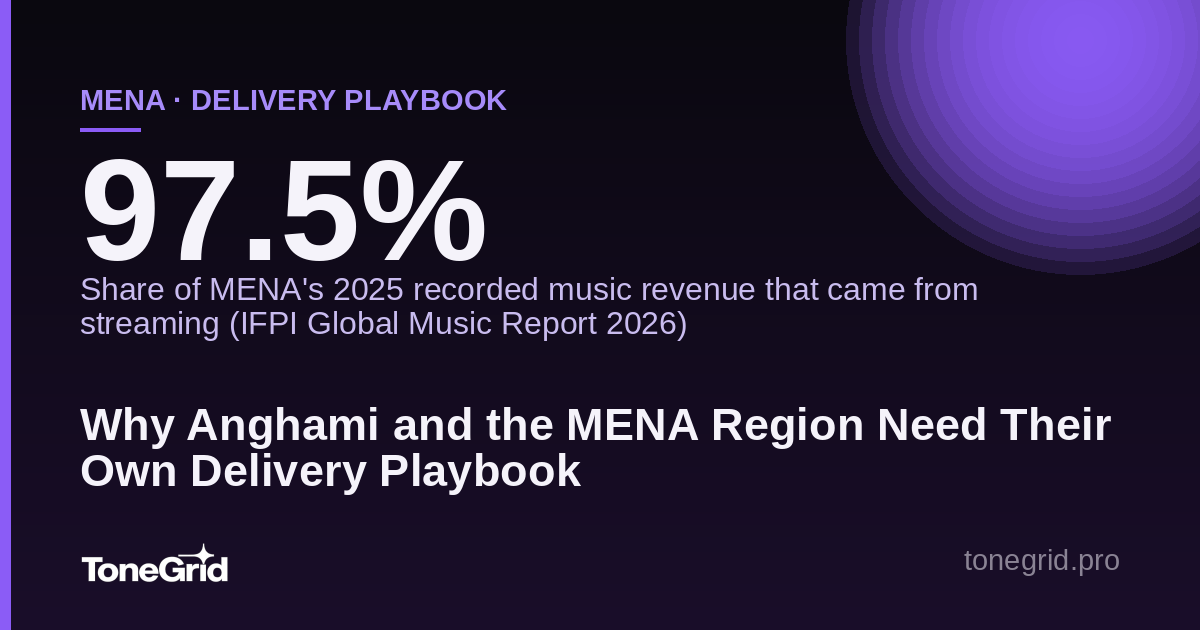
The Middle East and North Africa grew recorded music revenue 15.2% in 2025, tied with Sub-Saharan Africa as the joint second-fastest growing region globally, according to the IFPI Global Music Report 2026. Streaming accounted for 97.5% of that revenue, one of the highest streaming shares of any region on earth. It is also one of the least understood regions in most distributors' delivery playbooks, because the standard advice, "ship it to Spotify and Apple Music and you're covered," is wrong here in a specific and fixable way.
Anghami is not optional
Anghami is a home-grown platform, headquartered in Abu Dhabi and publicly listed, and it carries real weight across the Gulf, the Levant and North Africa in a way no international platform fully replicates. A catalogue that lands on Spotify and Apple Music but skips Anghami is not "mostly covered" in this region. It is missing the platform a meaningful share of the actual audience opens first.
On the delivery side the mechanics are standard: Anghami takes DDEX ERN direct via SFTP, certified, with a two-day turnaround on both new releases and metadata updates. The difficulty in MENA distribution is not the pipe, it is what goes through it.
Right-to-left is a metadata problem before it is a design problem
Arabic, like Hebrew, reads right-to-left, and that has real consequences for a DDEX delivery that was built and tested against left-to-right languages first. Title and artist fields need to carry correctly-encoded Arabic script without corruption, bidirectional punctuation and mixed Arabic-Latin strings (a common case when a track title mixes an English hook with an Arabic verse) need to render in the right order, and search only works if the platform on the receiving end gets a clean field, not one mangled by an encoding assumption built for a different script.
Transliteration is the discovery problem hiding underneath it
The same challenge that makes Japanese metadata unforgiving (kanji, kana and romanisation held as genuinely separate values, not one derived from the other) shows up in Arabic in its own form. An artist or track name in Arabic script and its Latin transliteration are not the same field wearing two costumes. Listeners search in both, sometimes within the same session, and a distribution pipeline that only carries the Arabic form, or only the Latin one, is quietly cutting its own discoverability in half.
Release timing has a regional rhythm
Listening behaviour across the region shifts materially during Ramadan, a pattern documented across DSP editorial calendars and regional streaming reporting year after year. A release plan built purely around a Western release-day calendar, with no awareness of that shift, is optimising for a rhythm that does not apply to a meaningful part of its own target audience.
What this means for a white-label distributor
None of this requires a separate delivery pipeline for MENA. It requires a delivery pipeline that was built to carry non-Latin script correctly, hold transliteration as its own field rather than an afterthought, and reach Anghami on the same certified, direct terms as every other DSP in the matrix. That is a metadata and rights-intelligence problem, not a stores-list problem, and it is exactly the kind of detail that separates a platform that technically supports a region from one that was actually built to serve it.
Frequently Asked Questions
Is distributing to Spotify and Apple Music enough to cover the MENA region?
No. Anghami is a home-grown platform that carries real weight across the Gulf, the Levant and North Africa. A catalogue that skips it is missing a platform a meaningful share of the region's audience opens first.
Does Anghami support direct DDEX delivery?
Yes. Anghami takes DDEX ERN direct via SFTP, certified, with a two-day turnaround on both new releases and metadata updates.
How much did MENA's recorded music revenue grow in 2025?
MENA grew recorded music revenue 15.2% in 2025, tied with Sub-Saharan Africa as the joint second-fastest growing region globally, with streaming accounting for 97.5% of that revenue, according to the IFPI.
Why does right-to-left script matter for music metadata?
Arabic reads right-to-left, so title and artist fields need correctly-encoded script, proper handling of bidirectional punctuation, and clean rendering of mixed Arabic-Latin strings. A pipeline built and tested only for left-to-right languages can mangle these fields.
Why does transliteration matter separately from the Arabic-script title?
Listeners search in both Arabic script and its Latin transliteration, sometimes in the same session. A distribution pipeline that only carries one form is cutting its own discoverability in half, the same problem Japanese kana and romanisation create in Asian metadata.
Related reading: Africa Is Not One Market, The Rise of Regional DSPs, Mobile Money, Not Cards. Full DSP coverage: /dsps. See the platform: /features.