Most distribution platforms were designed around an unspoken assumption: the artist getting paid has a bank account that takes dollars or euros, and a card network sits somewhere in the payment chain. Across most of Africa, that assumption is wrong often enough to matter, and it is one of the quieter reasons global platforms underperform for African labels even when their delivery pipeline works fine.
Cards were never the default here
Mobile money moved first and moved further across Sub-Saharan Africa than card infrastructure ever did. M-Pesa built that model out of Kenya. Nigeria layered Paystack and Flutterwave on top of local bank rails and mobile wallets. Francophone West Africa runs largely on Orange Money and MTN Mobile Money, tied to carrier billing rather than a bank at all. An artist in Lagos, Nairobi or Abidjan is far more likely to hold a mobile wallet than a card that clears an international payment gateway without friction.
A payout stack that only speaks Visa, Mastercard and SWIFT wire is not a minor inconvenience for that artist. It is the difference between getting paid and not.
What an infrastructure-first payout model actually looks like
ToneGrid pays out royalties on a monthly cycle, landing in the client's account 10 to 15 days after the earning month closes, not the 60 to 90 day lag artists have learned to expect from legacy distributors. Payout methods include wire, PayPal and Payoneer alongside Paystack for Nigeria and Flutterwave across the wider continent, so a tenant's payout rail matches how their own artists are actually banked rather than how a platform built in another region assumes they should be.
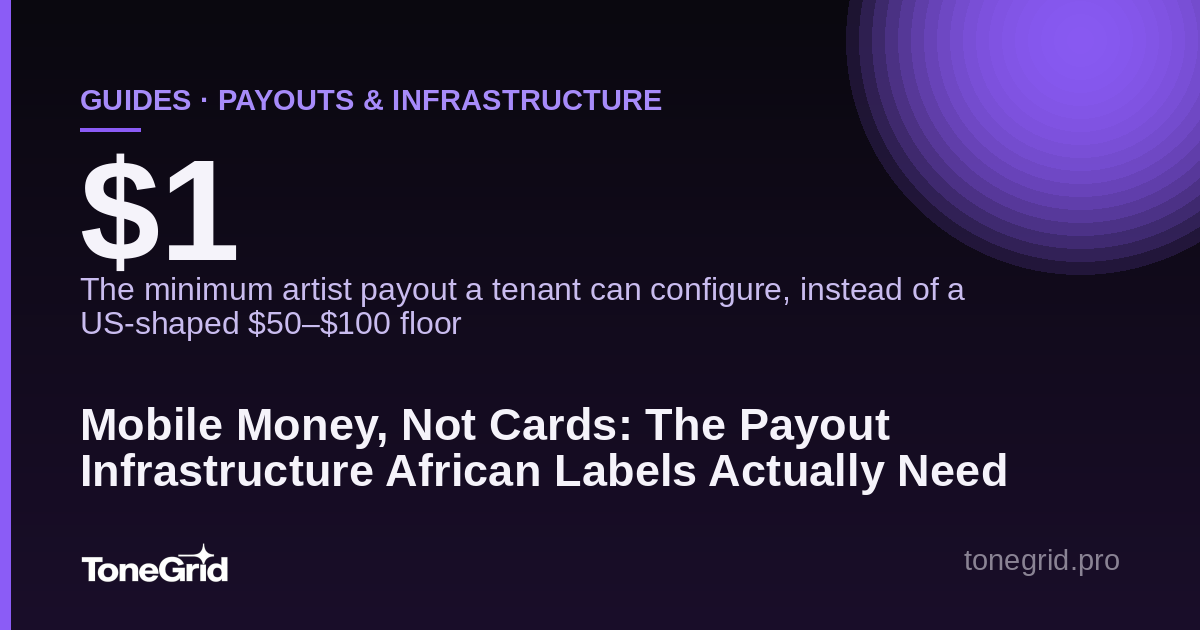
The threshold matters as much as the rail. A minimum payout set at $50 or $100 with no flexibility locks out exactly the artists a mobile-money-first market is full of: real earners, small catalogue, local currency. A white-label distributor should be able to set that floor to whatever fits its own artist base, down to $1, because a platform-wide minimum designed for a US market punishes the market it claims to serve.
Currency is not a display problem
Reporting a Nigerian, Kenyan or Ivorian artist's earnings in USD without a clear, current conversion is a trust problem, not a formatting one. Currency should be detected and converted at the prevailing interbank rate on the date of payment, and shown in the currency the artist actually thinks in, not just the currency the platform's backend happens to store.
Why this belongs in the same conversation as delivery
Direct DDEX delivery to Boomplay, Audiomack and every other DSP that matters in the region gets a release live. It says nothing about whether the artist who made it can actually collect what it earns. For a white-label distributor evaluating infrastructure to build a business on, the payout rail is not a back-office detail, it is as much a part of the supply chain as the delivery pipe itself, and it is usually the part a platform built outside the region got wrong first.
Frequently Asked Questions
Why don't card-based payout systems work well for African artists?
Mobile money moved further across Sub-Saharan Africa than card infrastructure ever did. Many artists hold a mobile wallet, not a card that clears an international payment gateway, so a payout stack limited to Visa, Mastercard and SWIFT wire fails a meaningful share of them before a single stream is ever monetised.
What payout methods does ToneGrid support for African labels?
Wire transfer, PayPal and Payoneer, alongside Paystack for Nigeria and Flutterwave across the wider continent, so a white-label distributor's payout rail matches how its own artists are actually banked.
How often are royalties paid out?
On a monthly cycle, landing 10 to 15 days after the earning month closes, rather than the 60 to 90 day lag artists have learned to expect from legacy distributors.
Can a distributor set a low minimum payout for small-catalogue artists?
Yes. A platform-wide minimum of $50 to $100 locks out real earners with small catalogues paid in local currency. Minimum payout should be configurable by the tenant, down to as little as $1.
Why does currency conversion matter for royalty reporting?
Reporting earnings in USD without a clear, current conversion is a trust problem. Currency should be detected and converted at the prevailing interbank rate on the payment date, and shown in the currency the artist actually thinks in.
Related reading: Africa Is Not One Market, Royalty Essentials for Independent Labels, Why Anghami and MENA Need Their Own Delivery Playbook. See the full plan structure: /pricing.